
NEO SynBlend — Online Blending Optimisation and Intelligent Control System
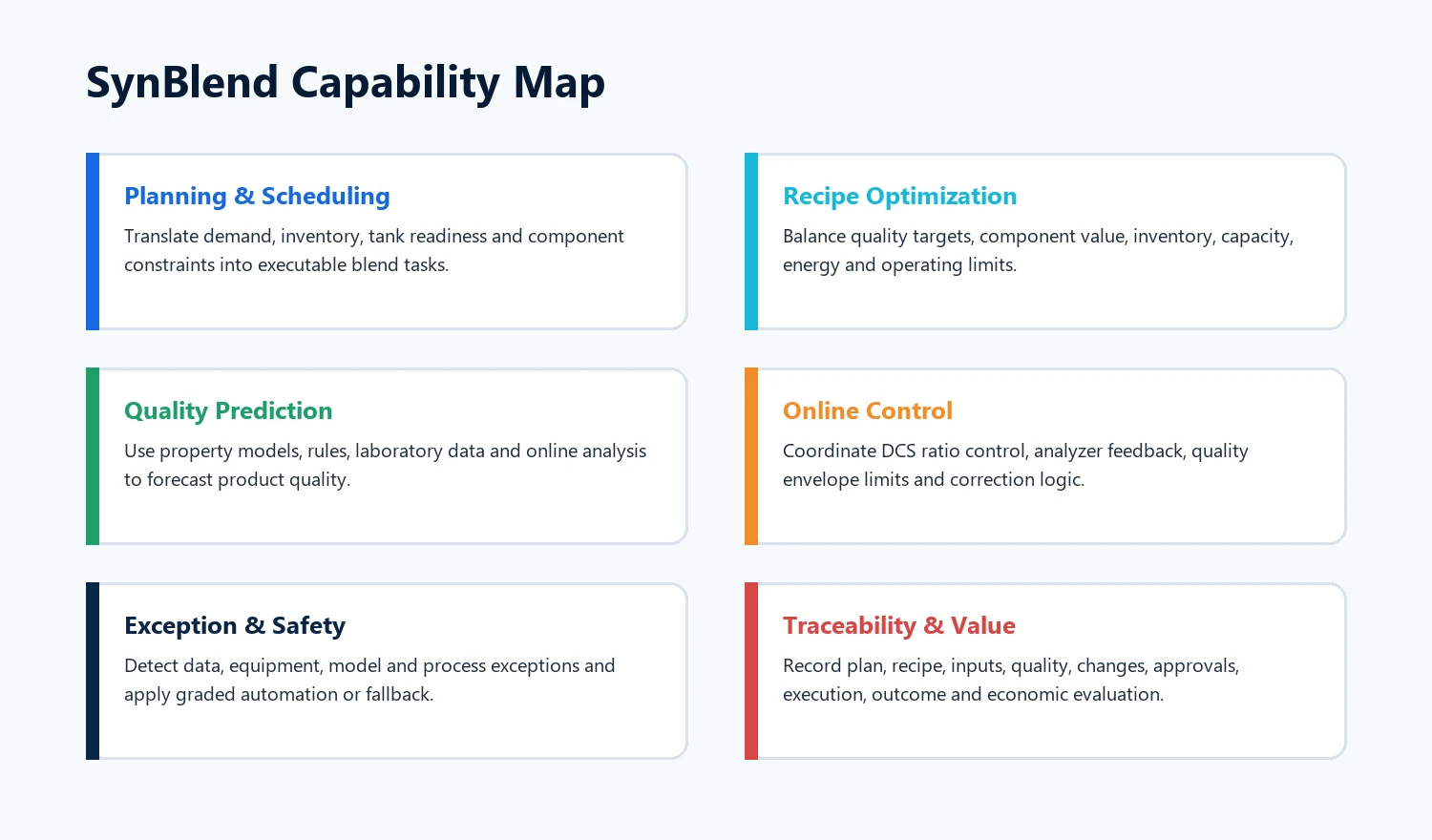
SynBlend connects planning, recipes, component properties, laboratory data, online analysis and DCS execution to help refined product teams meet quality targets with better component use, tighter control and complete traceability.
Within approved product-quality, equipment, safety and operating boundaries, SynBlend helps teams select better component combinations, reduce avoidable quality giveaway, execute recipes more consistently, and preserve complete decision and production traceability.
| PREDICT Quality and constraint outcome before execution | OPTIMISE Component use, margin, inventory and operations | CONTROL Authorised DCS execution with quality feedback |
The Problem: Quality and Economics Are Hard to Optimise Together
Traditional tank-to-tank blending often relies on conservative recipes, delayed laboratory confirmation, repeated adjustment, and fragmented coordination between planning, process, laboratory, operations and control teams.
| Challenge | What it costs |
|---|---|
| Low first-pass success | Conservative or inaccurate recipes create repeated sampling, reblending, tank occupation and schedule disruption. |
| Quality giveaway | Excess octane or other quality margin consumes higher-value components without creating additional saleable value. |
| Fragmented data | Component properties, inventory, lab results, online analysis, limits and execution records are not synchronised. |
| Global optimisation difficulty | A locally attractive recipe can create downstream shortages, tank conflicts, bottlenecks or higher total cost. |
| Delayed quality feedback | Laboratory confirmation arrives after material has moved, limiting timely correction. |
| Execution variation | Flow control, equipment state, analyser health and operating response can cause the actual blend to diverge from plan. |
Positioning and Standards
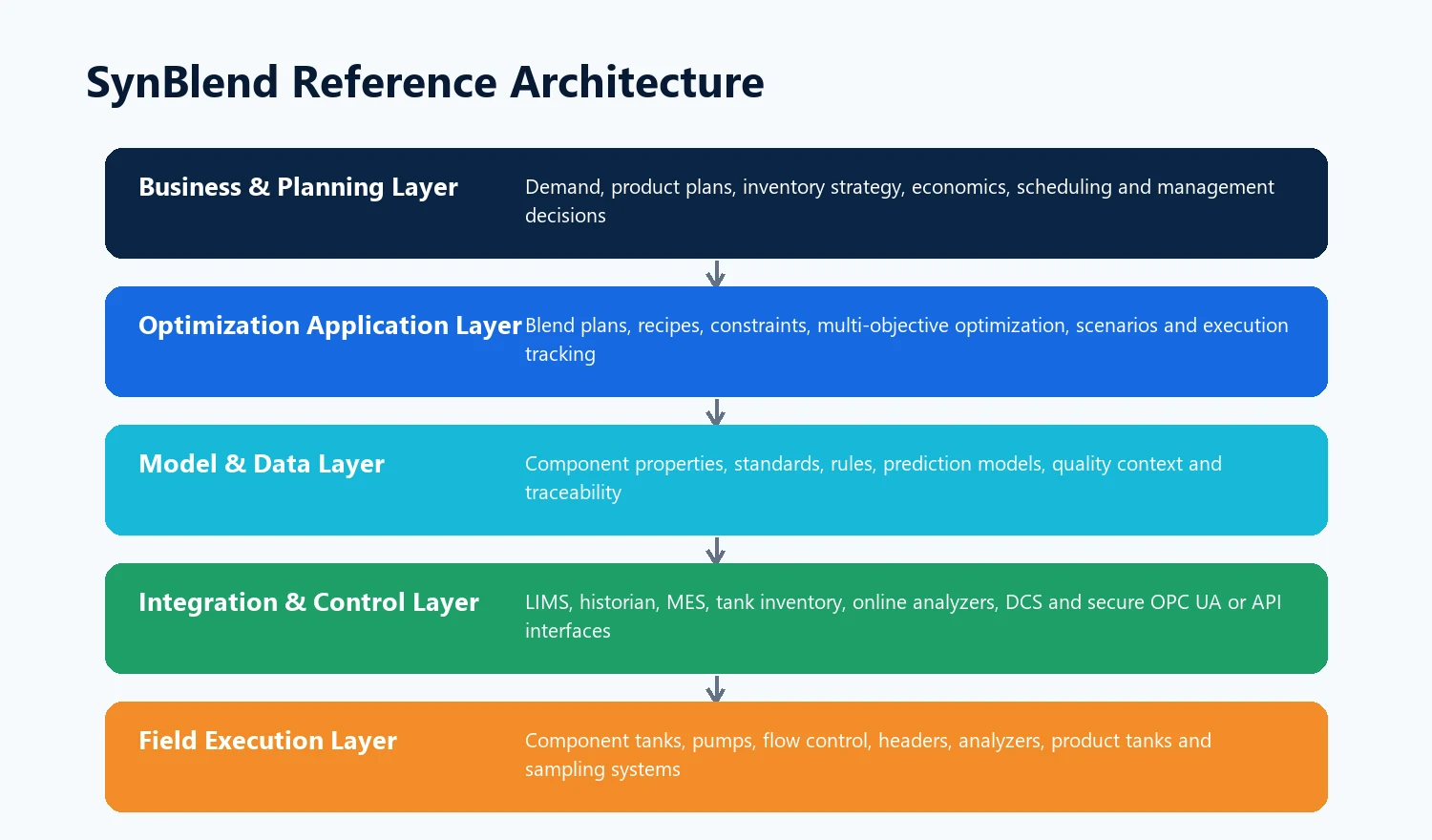
SynBlend does not replace the laboratory, historian, inventory system, MES or DCS; it connects their data and decisions into a governed blending workflow. Product release authority, custody transfer, laboratory methods, safety limits, interlocks and operating procedures remain governed by the customer’s approved systems and processes.
| Reference | Application in the solution |
|---|---|
| GB 17930 — Gasoline for Motor Vehicles | Product grades and limits configured according to the applicable project edition and product scope |
| GB 19147 — Automobile Diesel Fuels | Diesel product requirements configured when included in project scope |
| EN 228 — Automotive Petrol | European gasoline requirements configured when included in project scope |
| ASTM D4814 — Automotive Spark-Ignition Engine Fuel | United States gasoline requirements configured when included in project scope |
| ISA-95 | Reference for business, operations management and control-layer integration boundaries |
| OPC UA | Secure interoperability pattern where supported and approved |
Standards boundary. Project implementation must confirm applicable national, local, enterprise, contract and product-grade requirements before configuration and acceptance.
Control boundary. The DCS remains responsible for deterministic control, permissives, interlocks and field execution. SynBlend provides plans, authorised recipes, optimisation recommendations, quality feedback and traceable adjustments according to the approved automation level.
The Blending Closed Loop
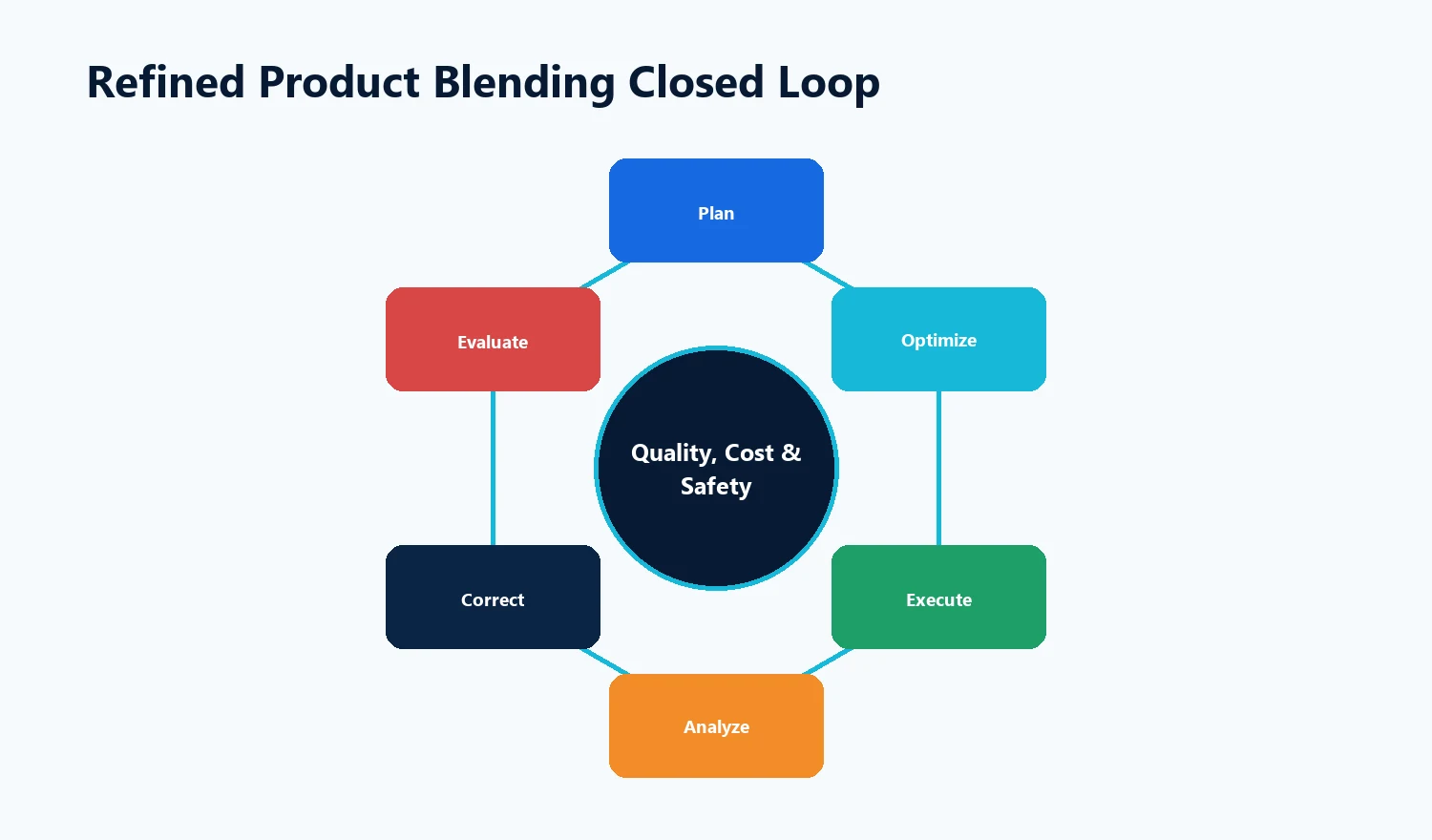
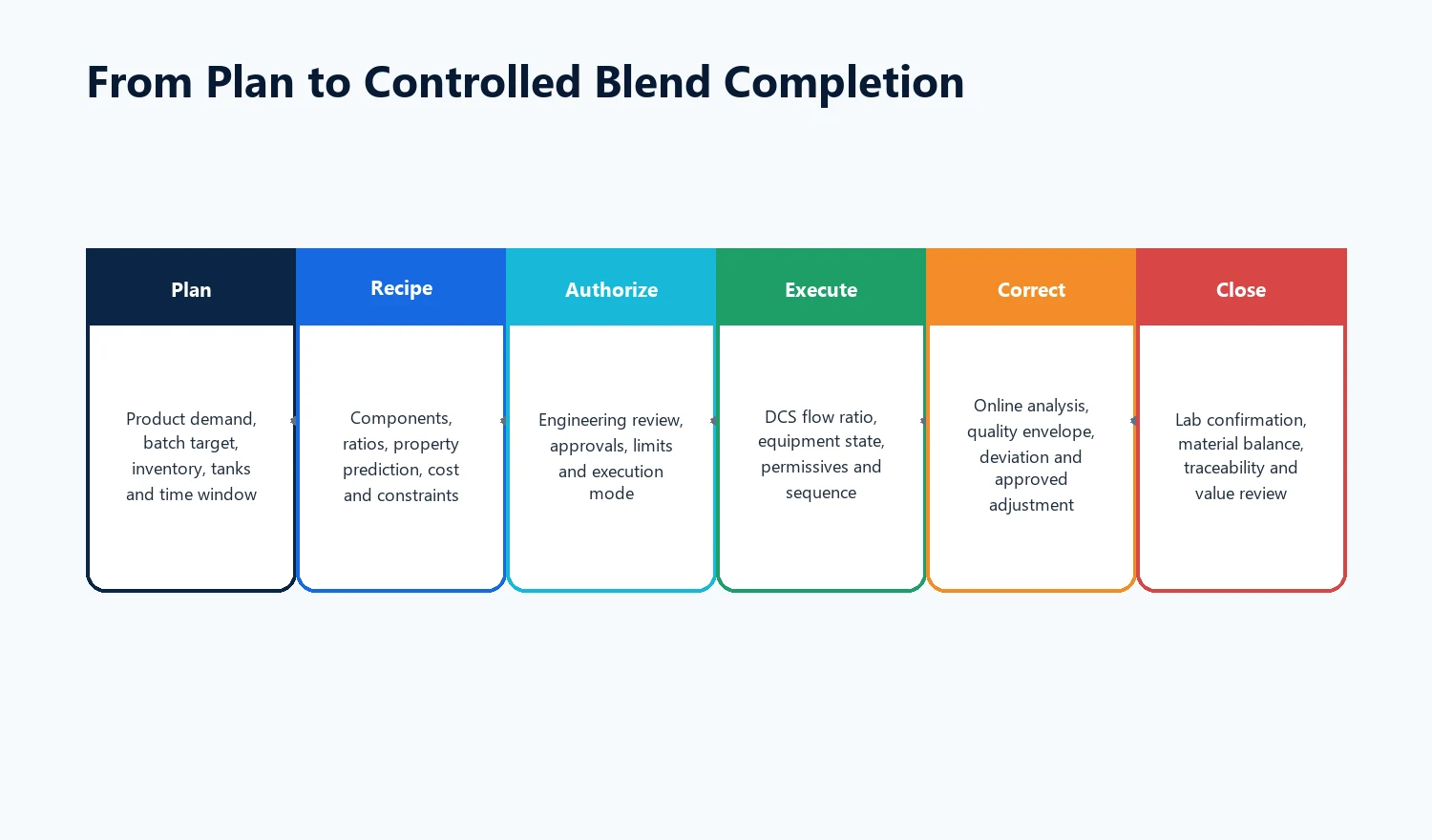
A blend task is planned against demand, inventory, tanks and timing; optimised against quality, cost and operating constraints; authorised for execution; monitored with flow, state and quality data; corrected within defined limits; and closed with laboratory, material-balance and value evidence.
Data, Rules and Models as Governed Assets
| Asset | Required content | Governance |
|---|---|---|
| Component master | Source, tank, availability, property basis, density, limits and commercial context | Owner, timestamp and effective state |
| Product specification | Grade, mandatory limits, internal target, guard band and release rule | Applicable edition and approval |
| Blending rules | Compatibility, minimum/maximum ratio, sequence, tank, equipment and operational restrictions | Version and engineering approval |
| Prediction model | Inputs, formula or model, range, training data, validation, uncertainty and fallback | Lifecycle and rollback |
| Execution context | Flow, valve, pump, analyser, unit state, event and operator action | Time-aligned traceability |
Model validity. A model result is usable only when required inputs have acceptable quality, the operating point is within the validated domain, the model version is effective, and any required approval is present.
Offline Optimisation: Compare Recipes Before Material Moves
| Dimension | What is evaluated |
|---|---|
| Objective functions | Minimise component cost, quality giveaway, energy, tank occupation, transition loss or deviation from plan |
| Quality constraints | Product limits, internal targets, guard bands, uncertainty and model validity |
| Material constraints | Available inventory, reserved volume, minimum heel, transfer limits and future demand |
| Equipment constraints | Tank compatibility, pump and line capacity, simultaneous operations, routing and maintenance state |
| Scenario comparison | Cost, quality margin, component consumption, feasibility, sensitivity and operational complexity |
| Approval package | Selected recipe, alternatives, assumptions, exceptions, reviewer, approver and effective window |
Optimisation boundary. An optimisation result is a decision proposal until feasibility, data quality, operating constraints, safety boundaries and authorisation are confirmed. The mathematically cheapest recipe is not automatically the executable recipe.
Quality Envelope Control
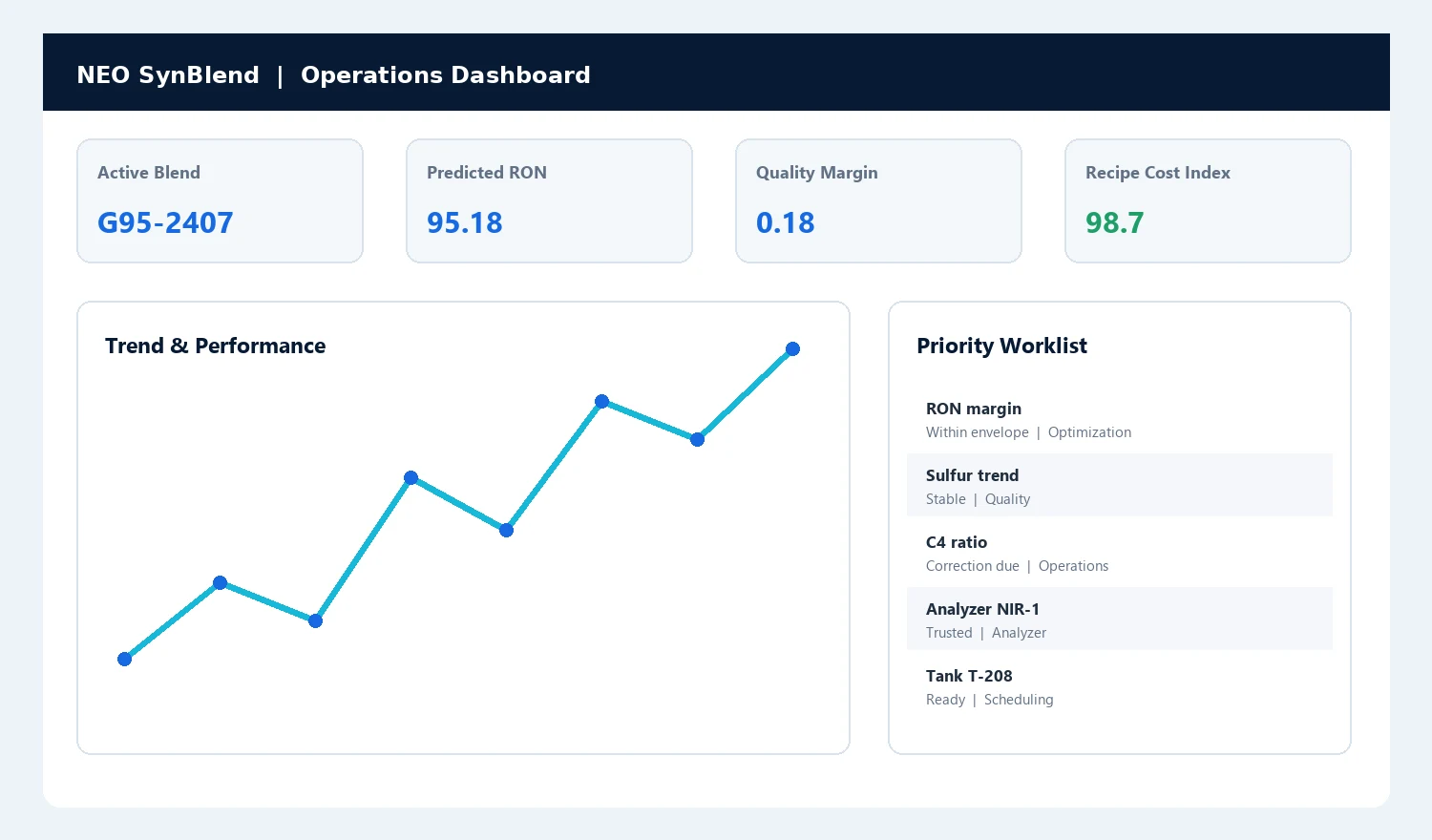
Quality envelope control keeps predicted and measured properties within approved operating bands while allowing controlled correction — this is where giveaway reduction comes from.
| Control element | Purpose | Example response |
|---|---|---|
| Target | Desired property value used by plan and recipe | Maintain planned component ratio |
| Operating band | Normal adjustment region considering uncertainty | Small bounded ratio correction |
| Warning band | Approaching internal or product boundary | Hold, request confirmation or tighten monitoring |
| Hard boundary | Safety, equipment or approved quality limit | Block adjustment, stop sequence or follow approved fallback |
| Data-quality state | Determines whether measurement or prediction may be used | Freeze, substitute, downgrade automation or sample |
| Model confidence | Indicates validity and uncertainty in the current operating region | Increase margin or return to conservative recipe |
No universal margin. Guard bands and quality targets are product- and site-specific. They depend on test methods, online analyser performance, model uncertainty, process variability, release rules and customer risk tolerance.
Graded Automation and Exception Handling
Read, recommend, or control. Each project defines a graded automation level: monitoring only, operator recommendation, operator-confirmed write, or approved closed-loop adjustment. Every level includes permissions, limits, timeout, fallback, logging and test evidence.
| Exception type | Designed response |
|---|---|
| Analyser exception | Bad quality, stale value, drift, maintenance or communication loss triggers hold, substitution, sampling or lower automation. |
| Model exception | Missing inputs, out-of-domain state, high uncertainty or expired version triggers conservative recipe or manual review. |
| Equipment exception | Pump, valve, line, tank, permissive or utility condition prevents or pauses execution. |
| Process exception | Flow instability, off-ratio behaviour, pressure or temperature deviation requires bounded correction or approved shutdown. |
| Integration exception | Network loss, duplicate command, stale acknowledgement or inconsistent state triggers timeout and reconciliation. |
| Authority exception | Missing approval, expired recipe, role mismatch or limit violation blocks action and records the reason. |
Safety principle. SynBlend never replaces DCS interlocks, permissives, safety instrumented functions, emergency shutdown, operating procedures or authorised operator judgement. HAZOP, cause-and-effect and control narratives govern final behaviour.
Integration
| System | Typical exchange | Key control |
|---|---|---|
| ERP / planning | Demand, order, product and commercial context | Approved scope and refresh |
| MES / scheduling | Production plan, task, grade, tank, campaign and status | State reconciliation |
| LIMS | Sample, method, result, approval and release context | Sample and time alignment |
| Historian | Process values, inventory, flows, events and trends | Time and quality integrity |
| DCS / PLC | Execution status, ratio, equipment state, permissives and authorised targets | Read-only default and bounded write |
| Online analyser | Quality result, diagnostics, status and quality code | Validity and fallback |
Implementation
| Phase | Main work | Exit criteria |
|---|---|---|
| 1. Discover | Confirm products, components, tanks, equipment, systems, standards, pain points and baseline | Approved scope and baseline |
| 2. Connect | Acquire inventory, property, lab, process, analyser and execution data | Traceable and time-aligned data |
| 3. Model | Configure rules, property models, constraints, scenarios and offline optimisation | Historical and scenario validation |
| 4. Execute | Launch plan, recipe, approval, DCS status, exception and closure workflows | Representative blend accepted |
| 5. Control | Introduce analyser feedback and graded automation with fallback and verification | Automation level accepted |
Recommended pilot: one representative product, a manageable component set, stable interfaces, usable laboratory and online data, a defined DCS boundary and a measurable baseline. Prove the complete loop before expanding product scope or automation.
Business Value
| QUALITY More stable results within approved limits | MARGIN Less avoidable quality giveaway | FLEXIBILITY Better use of inventory, tanks and components | TRACEABILITY Clear evidence from plan to final product |
| Value driver | Measurement approach | Boundary |
|---|---|---|
| Quality giveaway | Compare approved baseline margin with like-for-like production | Account for standards, uncertainty and grade mix |
| Component cost | Compare recipe and actual component consumption at agreed valuation | Account for inventory and opportunity cost |
| Reblend and delay | Track repeated adjustment, extra sampling, tank occupancy and schedule effects | Separate unrelated operating causes |
| Stability | Track first-pass result, deviation, correction and exception frequency | Use comparable operating periods |
Project boundary. ROI is calculated only from the customer’s validated baseline, agreed valuation method, realised use and acceptance evidence. Industry-level estimates are not customer commitments.
Request a SynBlend Blending Optimisation Assessment
Provide product types, annual production range, main components, tank and line arrangement, current DCS/LIMS/MES environment, available property and execution history, and the quality or cost issue of greatest concern. Our project team will prepare a scenario-based data list and pilot proposal.